About the Course
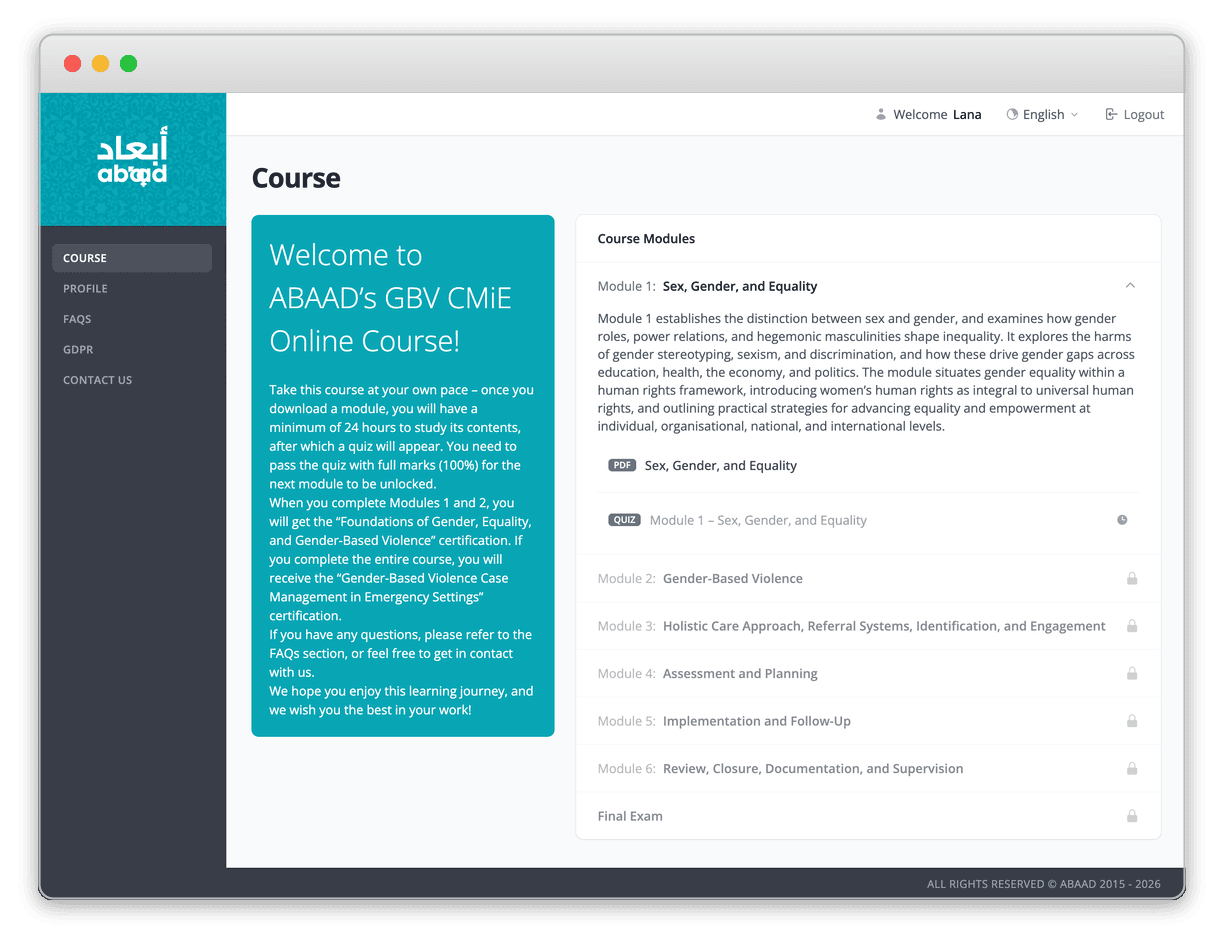
ABAAD emphatically believes that deepening understanding about gender, human rights, feminism, patriarchy, and the root causes of gender inequality and its consequent risks – is absolutely critical in the struggle towards ending gender-based violence (prevention), while providing safe, ethical, and high-quality care to survivors of GBV (response). At a time when rights are increasingly under threat and spaces for tolerance and equity are shrinking, this has become more urgent than ever.
This course was originally created in 2015, with the purpose of ensuring that GBV front-liners in low resource/emergency settings could access a comprehensive self-paced course that did not depend on consistent internet connectivity.
Over a decade later, in 2025, to ensure the course’s continued relevance, we have completely redeveloped the modules, integrating new concepts and best practices from the evolving GBV sector, drawing upon diverse and current sources.
To maximise relevance, reach, and accessibility, this course is open to all (no screening processes), completely free of charge, and available in seven languages: English, Arabic, French, German, Russian, Spanish, and Ukrainian – with hopefully more to come!
The course was developed by Jay Feghali, drawing on a wide array of global resources and guidelines including the GBV AoR, GBVIMS+, IASC, Interagency Guidelines, UNFPA, UNHCR, UN Women, and the WHO, in addition to the earlier 2015 modules developed by Dr. Jean Kors and Dr. Lina Abirafeh. It was made available through the generous support of the European Union, the Ministry of Foreign Affairs of the Netherlands, and the Regional Development and Protection Programme (RDPP).
All rights are reserved to ABAAD and the author.
Objectives
Familiarise participants with foundational concepts of gender, equality, and GBV
Provide case managers with the knowledge and tools to provide quality care to GBV survivors
Summary
Module 1 — Sex, Gender, and Equality
Module 1 establishes the distinction between sex and gender, and examines how gender roles, power relations, and hegemonic masculinities shape inequality. It explores the harms of gender stereotyping, sexism, and discrimination, and how these drive gender gaps across education, health, the economy, and politics. The module situates gender equality within a human rights framework, introducing women’s human rights as integral to universal human rights, and outlining practical strategies for advancing equality and empowerment at individual, organisational, national, and international levels.
Module 2 — Gender-Based Violence
Module 2 covers the foundational concepts of gender-based violence. It begins by defining violence and its types, then zooms in on examining GBV and how it arises from harmful gender norms, power imbalances, and discrimination, with a focus on intersectionality. It explores the root causes, forms, and categories of GBV, as well as its wide-ranging health, psychosocial, and legal consequences. M2 presents a dual approach to addressing GBV, outlining prevention strategies alongside survivor-centred response services and the role of legal and policy frameworks in reducing harm and strengthening protection.
Module 3 — Holistic Care Approach, Referral Systems, Identification, and Engagement
Module 3 introduces the rights-based Holistic Care Approach. It clarifies the distinction between Holistic Care (the overarching vision addressing survivors’ physical, emotional, social, and economic needs) and Case Management (the structured process that coordinates this care). The module highlights core survivor-centred principles, including safety, confidentiality, dignity, self-determination, and non-discrimination, and covers essential foundations for effective response, emphasising survivor empowerment and informed decision-making.
Module 4 — Assessment and Planning
Module 4 focuses on the critical stages of Assessment and Planning within the Holistic Care Approach. It explains how comprehensive, survivor-centred, and trauma-informed assessments identify risks, needs, and priorities through systematic processes and appropriate data collection. It also details survivor-centred planning (Care and Safety plans), ethical referrals, monitoring, and risk mitigation. Throughout, the module emphasises survivor autonomy, informed consent, confidentiality, and non-discrimination as the key foundations for responsive and empowering care.
Module 5 — Implementation and Follow-Up
Module 5 focuses on the dynamic stages of Implementation and Follow-Up. It frames implementation as a survivor-led process in which care plans are put into action, adapted as needed, and coordinated through safe referrals. The module emphasises continuous risk assessment, the Do No Harm principle, and clear documentation, recognising the care plan as a living document. It also presents follow-up as an ongoing, survivor-driven review process to ensure care remains safe, relevant, and responsive to changing circumstances, needs, and risks.
Module 6 — Review, Closure, Documentation, and Supervision
Module 6 covers the final stages of review, closure, and documentation. It differentiates between ongoing follow-up from formal case review, used to assess the relevance and effectiveness of the care plan and determine readiness for ethical closure once safety and agreed goals are achieved. The module outlines safe closure criteria and case transfer processes, as well as secure documentation and record management. Finally, it emphasises the importance of supervision and professional support for HCMs.
Benefits
Certification
The course offers two certification pathways:
- Foundations of Gender, Equality, and Gender-Based Violence: Awarded upon successfully completing Modules 1 and 2 along with their quizzes. You do not have to complete the remaining modules. This is an ideal certification for any rights activists, humanitarian and development sector practitioners, and academics seeking solid grounding in core gender and GBV concepts, particularly to support gender mainstreaming in programme design, and/or to advance gender equality, women’s empowerment, and women’s human rights.
- Gender-Based Violence Case Management in Emergency Settings: Awarded upon successful completion of all six modules and the final exam. This certification is designed for Holistic Care Managers, social workers, and other frontline personnel working directly with GBV survivors who wish to strengthen their technical knowledge and practical skills in line with internationally recognised standards.